
Heavy shipments or shipments that are large in size are typically more expensive to transport. Dimensional weight (also called volumetric weight) is a measurement carriers use to relate a shipment's size to its actual weight. Carriers charge postage based on the greater of the two: actual (scale) weight or dimensional weight.
For example, a light shipment packaged in a large box (10" × 10" × 10") might have an actual weight of 3 lbs, but a dimensional weight of 7.19 lbs. In this case, postage is calculated using the dimensional weight.
Be sure to reference the service details to determine if the dimensional weight exceeds the allowable maximum limit. For example if you are shipping with Chit Chats Canada Tracked reference service details for maximum allowable rate here. Or if you are shipping with Chit Chats U.S. Edge you can reference the maximum allowable rate here.How it's calculated
The formula depends on which Chit Chats service you're shipping with:
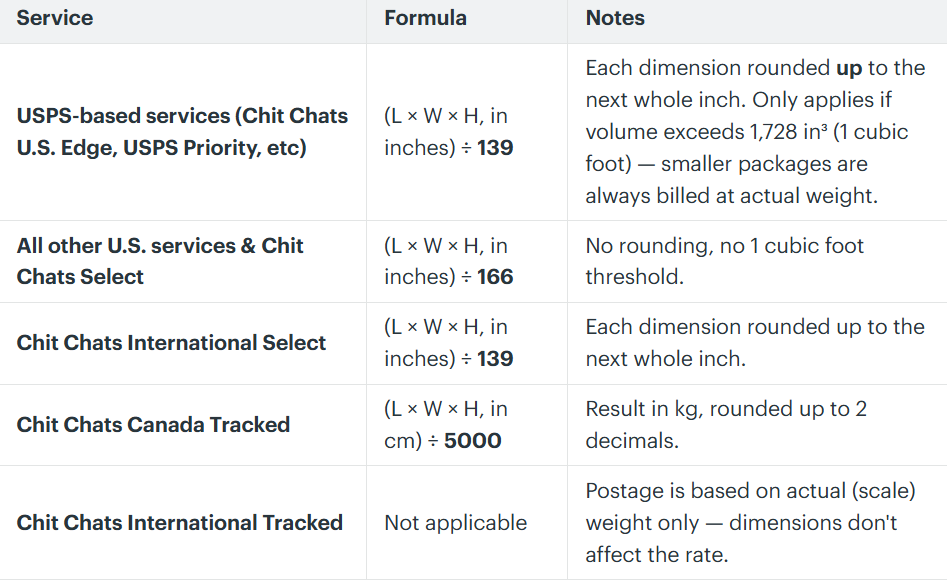
The divisor for USPS based services changed from 166 to 139 on July 12, 2026, matching a USPS-wide pricing change — USPS final rule.
In every case where dimensional weight applies, you'll be charged for whichever is greater: your shipment's actual scale weight, or its calculated dimensional weight.
Why this matters
Because most carriers enforce maximum weights and dimensions, if your shipment's dimensional weight exceeds a service's limit, you won't be able to get a rate for that service at all. Use packaging that is suitable to your item's size and contents, and make sure you report weight and dimensions accurately — inaccurate measurements can lead to a postage adjustment after the shipment is picked up and re-measured.
Surcharges may apply for oversized and irregular shipments.