
When shipping internationally, additional tariffs, duties, and customs fees may apply. Understanding how these fees are calculated can help you better prepare for your shipments. Learn more below about how tariffs and duties are determined for shipments to the U.S. and the EU.
U.S. Shipments
All U.S. bound shipments must use Delivered Duty Paid (DDP). This means that all shipping options will require you to pay the applicable tariff and duties upfront prior to shipping (unless an exception applies).
Keep in mind that for our U.S. postages you must include the following information:
A valid 10 digit HTS code
*For USPS-based postage options (Chit Chats U.S. Edge, USPS Priority Mail, etc), manufacturer information is required as well.
If you see the error Invalid HTS Code Detected in the tracking events, please check to ensure that is valid and accurate on the U.S. official site.
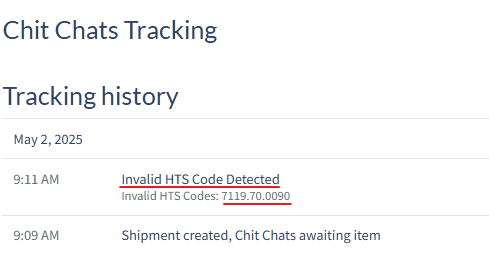
Tip: If you require assistance in finding valid HTS codes, consider using the user-friendly Chit Chats HTS Lookup Tool and cross reference with the official U.S. Harmonized Tariff Schedule website.
Important: For products with a Country of Origin being China or its special regions, each Chinese origin product line (distinct HTS code) within a shipment can only have a maximum value of $250 USD. If the value exceeds $250, you will be unable to ship the product with Chit Chats. This restriction applies to all U.S. bound services.
While we are experts in shipping logistics and providing solutions to get your goods into the U.S., we are not licensed customs professionals and do not specialize in tariff classifications or trade compliance matters.
For questions specifically related to HTS codes, country of origin, CUSMA regulations, we strongly recommend consulting a licensed customs broker or trade compliance expert. That said, we’re always here to help guide you through the process and connect you with trusted resources when needed. Our goal is to make your cross-border shipping experience as smooth and efficient as possible.
How are Duties & Tariffs Calculated?
Duties and tariff fees are calculated by the duty rate indicated in the official U.S. Harmonized Tariff Schedule website, the sold value of the goods, and the Country of Origin. This is why it is extremely important to include a valid HTS code at all times.
Depending on the product's HTS code, additional tariffs may apply (Section 232, 301, or 338).
It is important to take note that our platform does not import discounted rates from connected stores, with the exception of Shopify and Etsy. This is something that we are currently working on implementing for the other stores; in the meantime, please ensure that the values for your imported shipments are correct. Lastly, always include an invoice as documentation for U.S. customs.
What is a Section 232 Steel, Aluminum, or Copper Tariff?
Steel and aluminum tariffs based on Section 232 of the Trade Expansion Act of 1962 (Section 232) apply to the steel, copper, and aluminum content of products under certain HTS codes. At the moment, other metals such as titanium and platinum are not included in this category.
It’s important to note that CUSMA does not exempt products from Section 232 tariffs. Even if a product is CUSMA-approved, any applicable Section 232 fees must still be paid.
The Section 232 tariff can be calculated differently depending on the product and the guidance provided by U.S. authorities. Determined by the product’s HTS code, the tariff may be:
Calculated based on the metal content of the item
Assessed as a flat rate based on the total value of the product, regardless of its metal content; this is typically shown as Section 232 (Static) for tariff breakdowns.
For a full list of affected HTS codes, visit our comprehensive list.
How can I tell the percentage of metal in my product?
You can request this information from your manufacturer. If this information is not available from the manufacturer, comparable information for similar goods on the market can be used to determine the metal content of your product. It’s your responsibility to provide as accurate information as possible when making shipment declarations.
Failure to disclose the metal content in your products may result in a flat 50% tariff applied to your shipment item(s).
What if there’s no metal in my product?
Some items that require the steel, aluminum or copper content to be declared contain little or no metal. If there is no metal in the composition of your product, you would declare 0%.
How can I declare the content of metal in my product?
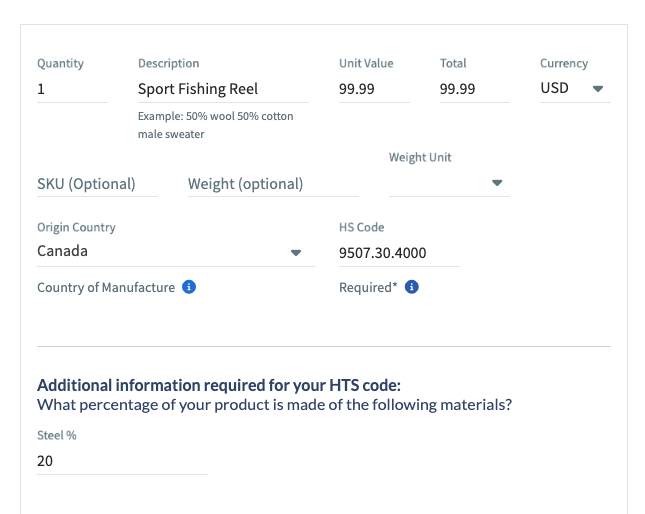
If you are creating shipments on the Chit Chats platform, if an applicable HTS Code is entered, a field for the additional information will appear (per screenshot below.)
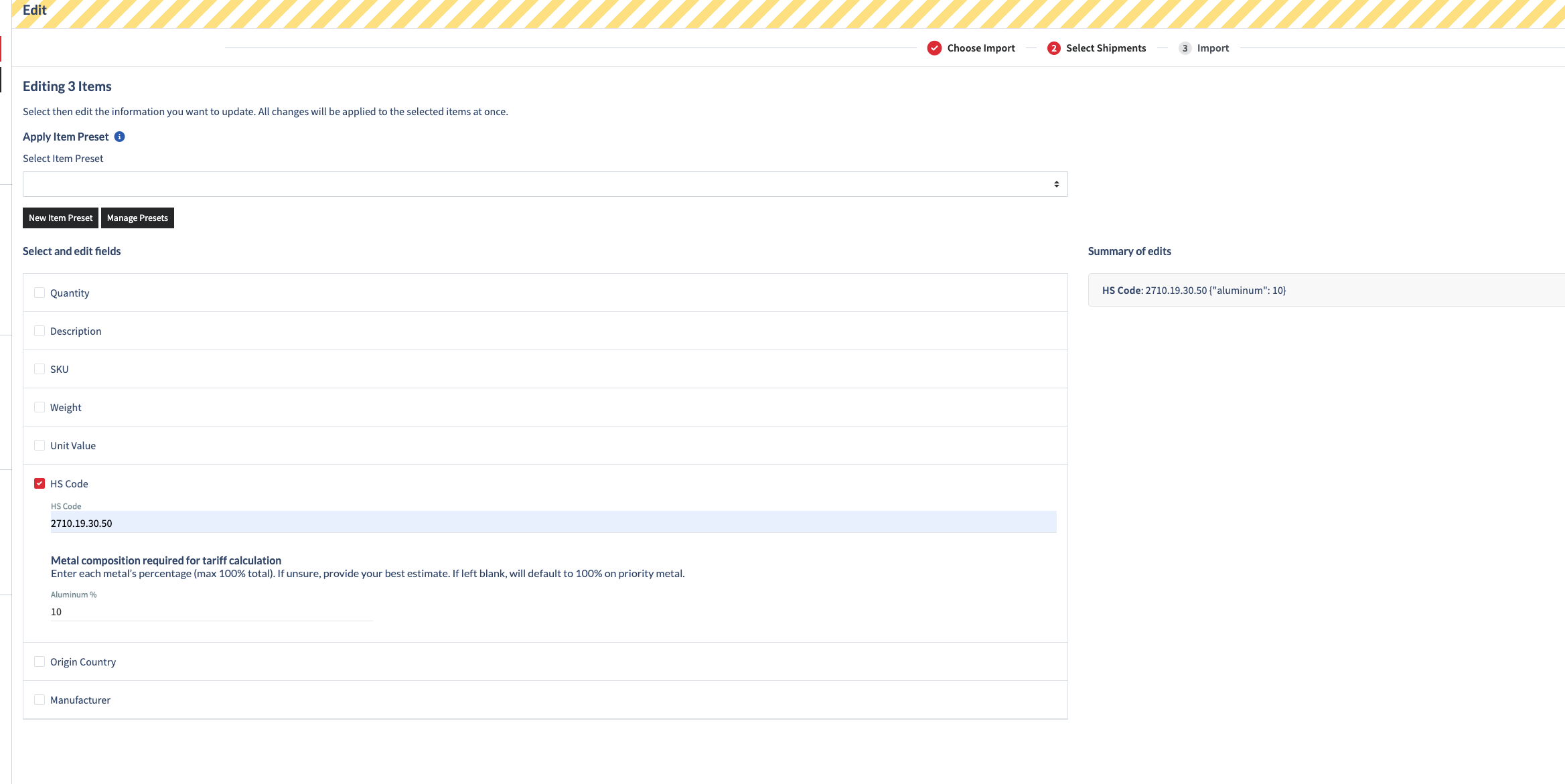
If you import via Chit Chats CSV, or via Store Integration, it’s recommended that you create shipment item presets to capture this information. You can edit the metal content of your items during import via the Edit Order Item tool, under the HS Code option:
Is my item’s packaging subject to this tariff?
If your product is packaged in a metal container, the packaging itself may also be subject to tariffs. In such cases, the product must be declared as containing at least 50% metal, depending on the actual composition of the contents.
For example, if a map is packaged in an aluminum tube, the product must be declared as containing 50% aluminum.
U.S. Shipping Fees
You will see different fees associated with DDP postage:
Tariff
Combination of the general rate of duty and any applicable ad valorem tariffs
An item could be duty-free but blanket tariffs may still apply.
Customs Processing
Flat fee per shipment, covering administrative costs for informal entry into the U.S. It is a flat fee per shipment (1.35 USD flat fee).
Fee is applied regardless of CUSMA eligibility, as all shipments are presented to Customs.
Broker Line Item
Fee for our broker to process the individual line items in the shipment (0.15 USD/line item). Example: You ship 1 tshirt, 2 mugs and 3 pens = 3 shipment items
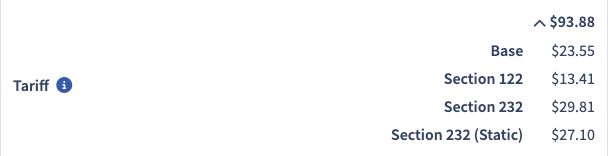
When purchasing postage, you can review the full breakdown of the total tariff fee, with each component clearly outlined, as shown below.
Base: The standard tariff rate determined by the applicable HTS code.
Section 232: A tariff calculated based on the metal content of the item.
Section 232 (Static): A tariff applied to the total value of the item, regardless of the percentage of metal content, as determined by the HTS code.
Section 301: A tariff applied to certain countries that the U.S. administration deems to participate in unfair trade practices.
Learn more about tariff categories here.
Note: A single item will never be subject to both Section 232 and Section 232 (Static). However, both may appear within the same shipment if it contains multiple items with different Section 232 tariff applications.
This is also accessible in the right-bar menu.
Chit Chats International Tracked to the U.S. has only tariff fees; the other two fees do not apply.
While we strive to provide the most accurate tariff estimates possible, these fees are determined by the U.S. administration and our customs broker; therefore, they may change without notice. As such, all tariff calculations are estimates only.
If an adjustment is required—whether due to an overestimate or underestimate—it will be automatically applied to your account and reflected in the Transactions section as either a refund or an additional charge, similarly to a postage adjustment.
Note: If a shipment has successfully crossed the border, please note that tariff fees are non-refundable, as they were required to facilitate clearance at the U.S.–Canada border. As a result, returned shipments are not eligible for tariff refunds.
International Shipments
EU Shipping Fees
International shipments with a VALID IOSS NUMBER destined for countries within the European Union will be subject to a €3.00 customs duty fee (~$4.87 CAD) and a €0.15 customs declaration fee (~$0.25 CAD) for each shipment item listed on the customs declaration.
*Note: Shipments destined for EU countries that do not include an IOSS number will require the recipient to pay any applicable customs duties, and Value-Added Tax (VAT) upon delivery.
IOSS numbers cannot be used for shipments over 150 euros.

Therefore, the €3 customs duty only applies to shipments valued at €150 or less. Shipments valued over €150 are not subject to this duty and will continue to be assessed duties and taxes based on the value of the shipment.
These charges will appear as separate line items during postage purchase. Similar to the tariffs and customs-related fees applied to U.S.-bound shipments, these fees will be displayed separately within the postage cost breakdown to provide greater transparency into applicable import-related charges.
The fees are as follows:
Customs duty fee: €3.00 per shipment item
Customs declaration fee: €0.15 per shipment item
This results in a total fee of €3.15 (~$5.12 CAD) per shipment item, in addition to the shipment's postage.
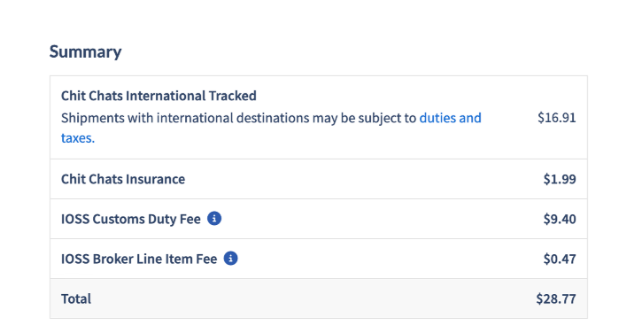 *Currencies are automatically converted to CAD
Example:
If your shipment contains:
1 T-shirt
2 mugs
3 pens
and each product is listed as its own line on the customs declaration, the shipment contains 3 shipment items, resulting in a total fee of €9.45 (3 × €3.15).
Note: Shipment items are determined by the number of lines on the customs declaration, not the quantity of products. For example, if you list 1 red pen and 1 blue pen on separate lines, they count as 2 shipment items, even though there are only two pens.